What if the car didn't come?
The most important person in the lives of thousands of Norwegians sits behind a steering wheel. Most of us never actually see him.
We grumble briefly. Some turn into "Karens", others simply get on with it, and we all move on. Not everyone can.
The Romans called it the cursus publicus, the public road. A network of highways, staging posts and couriers that held the Empire together from Hadrian's Wall to Mesopotamia. Without it, the laws would never have reached the provinces, the grain would have rotted in Egypt, and the Emperor's will would have counted for rather little beyond the Forum. The Romans understood something we have rather forgotten to put into words. A society exists in its ability to move things from one place to another.
Do we take logistics for granted these days? Consider the example that keeps Norway alive. A lorry on the E6 over Dovre is intimately connected to a fridge in Bergen. Why might Adam Smith, writing today, reach for a driver from Meny to illustrate how the market actually works?
The bloodstream of society
The metaphor of society as a body is an old one. In Plato we already find the analogy of the state as an organism, each class an organ with its function. Plato, it must be said, was rather preoccupied with the head. The philosophers were to do the ruling. It is time to turn our gaze to the blood vessels.
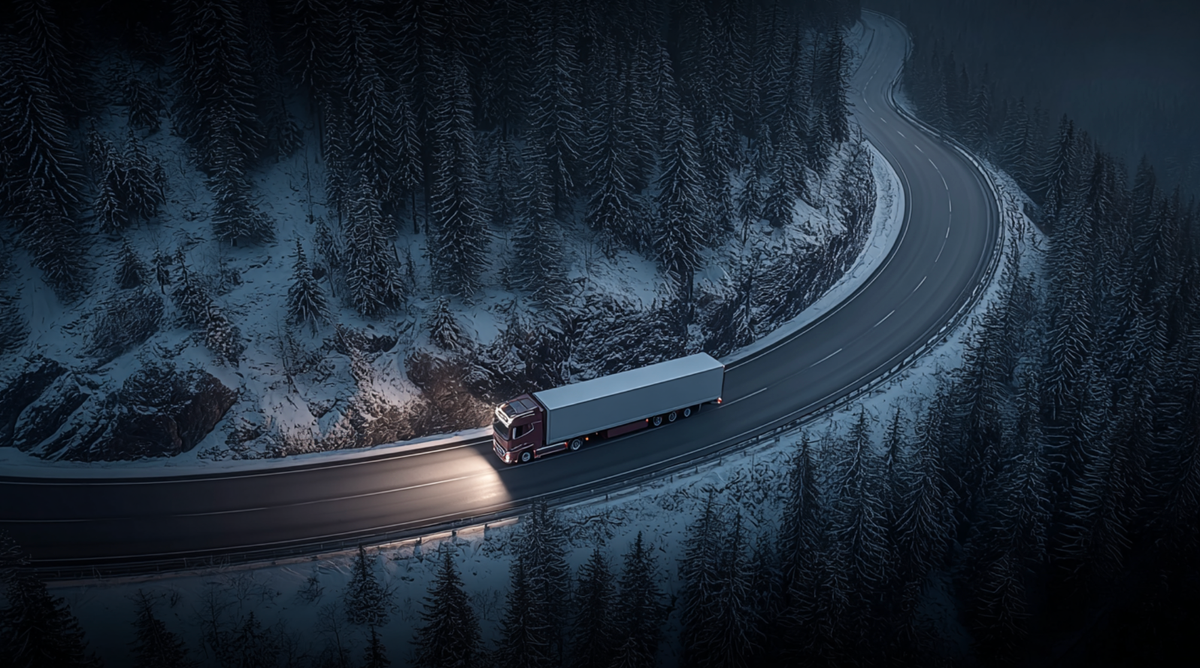
Logistics is the circulatory system of the social body. When you see an ASKO lorry inching its way over a mountain pass, you are not just watching a transport vehicle. You are watching oxygen on its way to the cells. You are watching nourishment bound for tissues that would otherwise wither. It isn't terribly poetic, but it is all the more precise for that. Without the constant, monotonous movement of goods through the landscape, the organism dies.
For most of us, this system is invisible in the way good health is invisible. We notice it only when it fails. A late parcel, an empty shelf, a taxi that never came. We grumble briefly. Some turn into "Karens", others adapt, and we all move on. A small pinch of oxygen starvation, unpleasant but fleeting.
Just not for everyone.
Existential infrastructure
For a sizeable portion of the population, logistics is not a convenience. It is a lifeline. You cannot carry the shopping in yourself. The lift is broken and you are on the third floor with a wheelchair. The driver who was meant to take you to the one social outing of the week doesn't turn up.
For these people, a failed delivery is not a first-world problem to be held at ironic arm's length. Will there even be dinner? Will there be any human contact today at all?
It is the difference between company and isolation, between independence and dependence. Between dignity and humiliation.
The philosopher Martha Nussbaum has argued that human dignity cannot be measured in abstract rights alone, but in the actual capacity to live a full life.
Can you move about freely? Can you get hold of what you need? Can you take part in society on your own terms? For many disabled people, a driver is the difference between theoretical freedom and real agency.
Smith's visible hand
Adam Smith gave us the image of "the invisible hand" in The Wealth of Nations. The idea was that the market, through millions of small individual actions, coordinates resources for the common good without any central planner. An elegant concept, and one that captures something essential about how complex systems can appear orderly without a conductor.
Smith also wrote another book, The Theory of Moral Sentiments. In it he argued that the human capacity to imagine oneself in another's shoes is the foundation of all morality, and of any decent society.
The invisible hand needs visible hands that care.
In today's Norwegian logistics, we see both at once. The system is invisible. Algorithms optimise routes, warehouse systems talk to shops, forecasts calculate demand, dispatchers send out cars. Then the goods reach the doorstep, or the driver arrives for the pick-up, and the whole thing becomes suddenly visible. A hand knocking on the door, carrying the bags in, setting them down on the kitchen counter because the driver can see that a little extra help is needed. Here the market's anonymous efficiency meets the concrete care of moral sympathy.
A helping hand in return
Disabled people can contribute to the system too. Out of sheer necessity, they've become experts in where it fails. They know the points at which infrastructure breaks down. They know where the routines don't hold, and where the human margins are too thin. This knowledge is invaluable. Disabled people can serve as a kind of CT scan of the social bloodstream. It shows the clots before they turn critical.
If we designed logistics systems robust enough for those who truly depend on them, they would be flawless for everyone else. That is engineering, not charity.
Credit where credit is due
The next time you see a lorry battling over a mountain in foul weather, a delivery van threading through tight streets at rush hour, or a tired driver lugging parcels up a flight of stairs, see them. Really see them.
They keep the organism alive. They are the visible hand in a system that too often takes them for granted. They are the blood cells that never rest.
For some of us, a successful delivery is a pleasant convenience. For others, it is the very symbol of freedom, and of the chance to live an independent life in a society not always built with them in mind. The driver who rings the doorbell is carrying rather more than groceries, or the possibility of an evening out. The driver is carrying dignity itself.
That is logistics in its truest form. The movement of things, and the chance to live a life. A system, and a promise that those who cannot turn up on their own will still have their share of the plenty.
The Romans understood it. Smith understood it. The question is whether we do.
Merry Christmas, and a proper, enormous thank you to all the drivers out there, from a group you mean the world to.